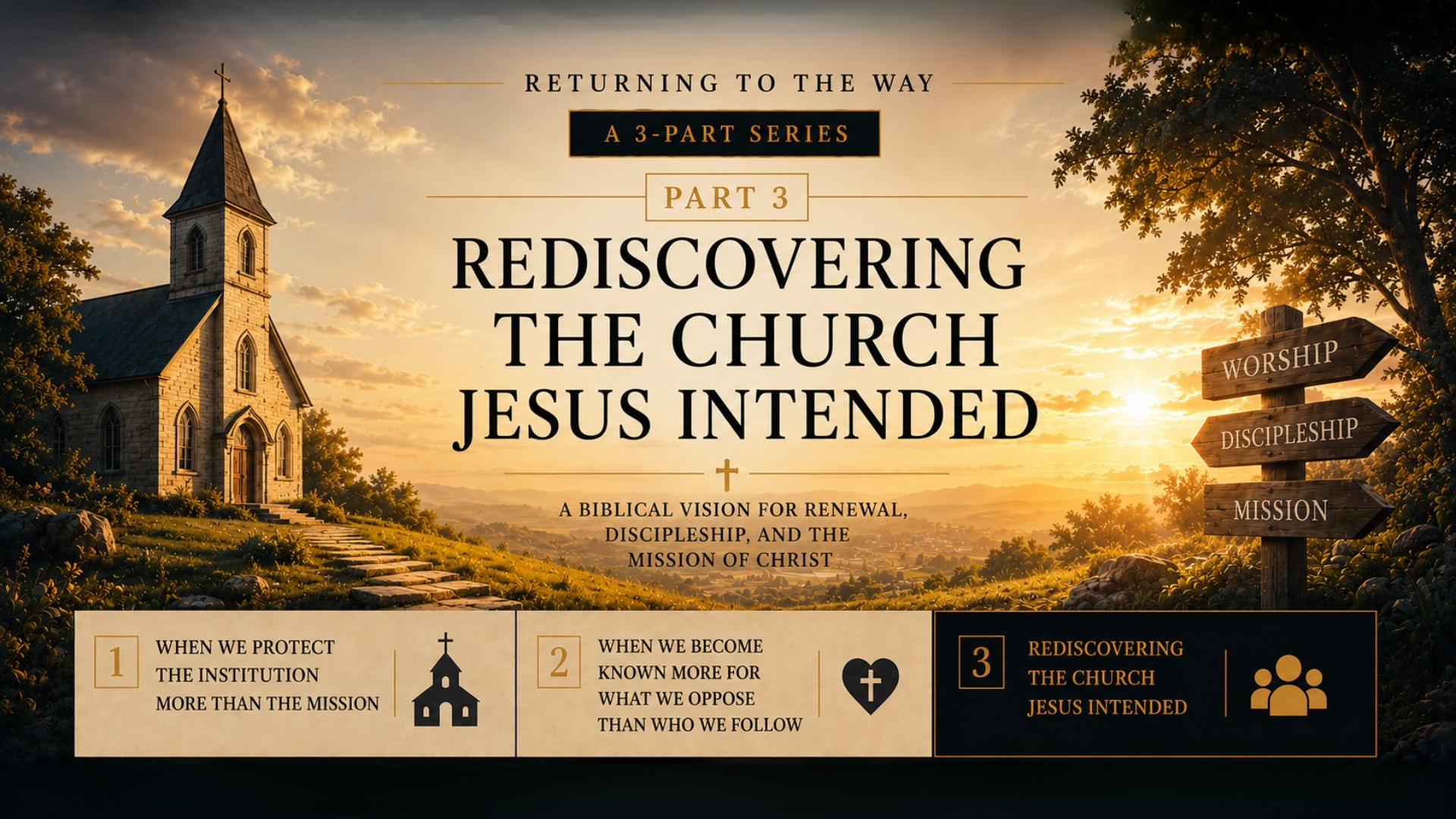
Returning to the Way (Part 3): Rediscovering the Church Jesus Intended
The goal of this series has never been criticism, it has always been restoration. In the final installment of Returning to the Way, we explore what it looks like to realign our churches and our lives with Christ's vision through servant leadership, biblical discipleship, repentance, and a renewed commitment to the Great Commission.
Series: Returning to the Way
A three-part series exploring how the Church can rediscover biblical discipleship, servant leadership, and the mission Jesus entrusted to His people.
You are reading: Part 3 of 3
If the first two parts of this series have posed tough questions, this last article aims to tackle one of the most crucial ones.
So, where do we go from here?
Recognizing that the Church has strayed in some areas is one thing. Figuring out how to react is a whole different ball game.
The easy choice might be to think that the solution is to walk away.
Walk away from the church.
Walk away from the denomination.
Walk away from organized Christianity.
Walk away from leadership.
Walk away from ministry altogether.
Many people have taken that route, believing that if the institution is flawed, then Christ must be sought outside of it.
But that’s not the message we get from the New Testament.
Jesus didn’t promise to establish a denomination.
He promised to build His Church.
The Church has never been owned by pastors, movements, traditions, or institutions. It belongs to Christ. This means that our reaction to brokenness isn't to walk away, it’s to actively engage in Christ's ongoing work of renewal.
Historically, whenever God has sparked revival among His people, He seldom begins by replacing the Church.
He starts by renewing it.
The prophets called Israel back.
Jesus called God's people back.
The apostles called the churches back.
Time and again, Scripture shows that God is all about restoring what has strayed rather than tossing it aside.
That truth should inspire hope in us.
The Church's most significant moments have never hinged on its perfection.
They have always relied on Christ's faithfulness.
If that’s the case, maybe our first question shouldn’t be, "How do we fix the Church?"
Maybe it should be,
"How do we become the kind of disciples Jesus can use to renew His Church?"
Renewal has always started with everyday people who fully surrender to God.
Before revival sweeps through cities, it starts in individual hearts.
Before churches transform, people must transform.
Before ministries thrive, leaders need to humble themselves before Christ.
Every enduring movement of God has followed this pattern.
So where do we kick things off?
We start with repentance.
Repentance is one of the most misinterpreted terms in modern Christianity. Many hear it and instantly think of shame or judgment. Biblically, repentance is something much more beautiful. It’s a gracious invitation to turn away from whatever has taken hold of our hearts and return to the God who has never stopped chasing after us.
Repentance isn’t just about admitting our sins.
It’s about reorienting our lives around Christ once more.
Maybe churches need to rethink measuring success by attendance rather than by discipleship.
Maybe pastors should rethink their focus on building platforms instead of nurturing people.
Maybe church members ought to reconsider their role as consumers rather than contributors.
Perhaps we all need to reflect on how we've let politics, personalities, traditions, or preferences take the place that should be reserved for Christ alone.
Repentance isn’t a sign of weakness.
It’s actually the gateway to renewal.
From repentance springs a fresh commitment to discipleship.
One of the most remarkable aspects of Jesus' ministry is how ordinary it often seemed.
He spent years walking along dusty paths.
He shared meals with others.
He responded to questions.
He posed questions.
He offered corrections.
He provided encouragement.
He listened intently.
He prayed fervently.
He poured himself into a relatively small group of individuals who would go on to change the world.
Jesus never seemed hurried.
He never mistook busyness for productivity.
He recognized that the Kingdom of God grows mainly through transformed individuals.
At some point, many churches became skilled at attracting crowds while unintentionally overlooking the slower, often hidden work of disciple-making.
Discipleship isn't usually about the spotlight.
It unfolds at dinner tables.
In cozy living rooms.
Over steaming cups of coffee.
During visits to the hospital.
In prayer gatherings.
Through genuine conversations.
By diving into the Scriptures together.
By supporting someone through their failures instead of walking away from them.
Discipleship isn't just another program in the Church.
It's the very heart of the Church.
When we put discipleship back at the center, leadership starts to change too.
Jesus redefined what greatness really means.
In a society where leadership often equates to power, influence, and fame, Jesus took a towel, wrapped it around His waist, and washed His disciples' feet.
The King became a servant.
That moment should always influence how Christians view leadership.
Biblical leaders aren't here to create their own empires.
They're here to help others thrive.
Their success isn't about how many people recognize their name, but about how many people grow closer to Christ because of their impact.
Healthy leadership leads to mature disciples.
It empowers instead of controlling.
It nurtures rather than overpowers.
It values faithfulness more than popularity.
One of the biggest changes the Church needs today is shifting from a performance-driven culture to one focused on presence.
Performance questions, "How impressive was Sunday?"
Presence questions, "Did we meet Christ?"
Performance wonders, "How many showed up?"
Presence wonders, "How many are growing closer to Jesus?"
Performance fills up schedules.
Presence changes hearts.
The early Church grasped something we really need to get back to.
Christianity was never meant to be just a weekly event.
It was a communal way of living.
Believers gathered for worship, but they also shared meals.
They prayed together.
They supported each other through tough times.
They looked after widows.
They were generous givers.
They welcomed newcomers.
Their faith reached far beyond the buildings where they met.
Maybe that’s why the Church grew with such incredible strength.
People didn’t just listen to sermons.
They saw a completely different lifestyle in action.
Just think about what could happen if churches were known for that again.
Picture communities where lonely individuals instantly found a family.
Where struggling marriages discovered mentors.
Where young believers found spiritual parents.
Where pastors saw their greatest achievement as raising new leaders rather than making themselves irreplaceable.
Where everyone realized that ministry is for every follower of Jesus, not just those with titles.
Imagine a place where disagreements are approached with humility.
Where repentance is something to celebrate.
Where forgiveness is a regular practice.
Where truth and love go hand in hand.
Would that make all problems vanish?
Not at all.
The New Testament clearly shows that churches will grapple with sin until Christ comes back.
But maybe our witness would start to resemble the Church that Jesus envisioned.
As I think about everything we've discussed in this series, one question keeps popping up in my mind.
If Jesus walked into our churches this Sunday, what would make Him rejoice?
I believe He would be joyful wherever people are truly worshiping Him.
Where the Scriptures are shared faithfully.
Where kids are learning the gospel.
Where the hungry are fed.
Where missionaries are sent out.
Where those in pain find comfort.
Where believers help each other with humility.
There’s so much good happening in the Church that social media often overlooks.
But I also think He would gently challenge us with tough questions.
Have you kept your first love alive?
Are you making disciples?
Are you serving others or just chasing status?
Are your traditions helping people follow Me?
Are you recognized for your love?
These questions aren’t threats.
They’re invitations.
Invitations to come back.
Invitations to remember.
Invitations to realign our lives with the One who called us.
The Church doesn’t need another celebrity.
It needs shepherds.
The Church doesn’t need another marketing strategy.
It needs disciples.
The Church doesn’t need more cultural influence if it compromises biblical faithfulness.
It needs greater surrender.
Long before the Church was recognized for cathedrals, conferences, publishing houses, podcasts, or denominations, it was known for something much simpler.
A group of everyday people had met the risen Christ.
They loved each other deeply.
They committed themselves to the apostles' teaching.
They shared meals.
They prayed together.
They served together.
They took the hope of the gospel to every corner of the world.
That’s still the mission.
It hasn’t changed.
The solution to the challenges the Church faces today isn’t to create a new version of Christianity.
It’s to rediscover the One who has always been at its core.
Let’s never get so focused on protecting our institutions that we forget the mission Christ gave us.
Let’s never get so caught up in winning arguments that we overlook the importance of loving people.
Let’s never get so busy building ministries that we forget to make disciples.
And let’s always remember that the hope of the Church has never depended on its buildings, budgets, traditions, or leaders.
Its hope has always been, and always will be, in Jesus Christ.
Maybe the greatest revival our generation could see wouldn’t start with bigger churches or louder voices.
Maybe it would start with believers quietly opening their Bibles again, humbly kneeling in repentance, faithfully loving their neighbors, boldly sharing the gospel, and intentionally making disciples one life at a time.
That kind of Church might never make the news.
But it will resemble exactly what Jesus intended.
Rooted Reflection
Throughout this series, we've tackled some tough questions about the Church, our priorities, and how we present ourselves to the world. But as we wrap things up, let's keep this in mind: the Church isn't just 'them'; it's us.
It's pretty easy to criticize the Church from afar. The real challenge is letting God take a good look at our own hearts. Renewal doesn’t kick off in church buildings, denominational offices, or on conference stages. It starts when everyday followers of Jesus decide to surrender their lives to Him.
The Church has never been transformed by people waiting for someone else to step up. It has always been revitalized by believers who quietly dedicated themselves to prayer, repentance, faithful obedience, and making disciples wherever God has placed them. You might never lead a massive church, start a movement, or write a bestseller, but each of us has the same calling: to follow Jesus and help others do the same faithfully.
As you wrap up this series, don’t just ponder what needs to change in the Church. Consider what Christ is inviting you to do next. Revival has never begun with large crowds; it has always started with individuals willing to say, 'Lord, start with me.'
Let’s strive to be people who are deeply grounded in God’s Word, constantly growing in Christ, and dedicated to reflecting His truth, love, and mission in every aspect of our lives.
Questions for Reflection
After reading this series, what has challenged me the most about my own walk with Christ?
Am I actively making disciples, or have I unintentionally settled into simply attending church?
In what areas of my life is Jesus calling me to greater humility, repentance, or obedience?
How can I better reflect both the truth and the love of Christ in my home, workplace, church, and community?
What gifts, experiences, or opportunities has God entrusted to me that I can use to strengthen His Church rather than simply consume it?
If every believer lived out their faith the way I do, what kind of church would we become?
What is one specific step I will take this week to intentionally invest in someone else's spiritual growth?
A Prayer for the Church
Father, thank You for the gift of Your Church. Forgive us for the times we have allowed our traditions, preferences, or agendas to take priority over Your mission. Teach us to love as Christ loved, to speak the truth with grace, and to faithfully make disciples wherever You have placed us. Begin Your work of renewal in our own hearts, and use us to strengthen Your Church for the glory of Your name. May everything we build point people to Jesus, and may our lives reflect the hope of the gospel until He returns. Amen.
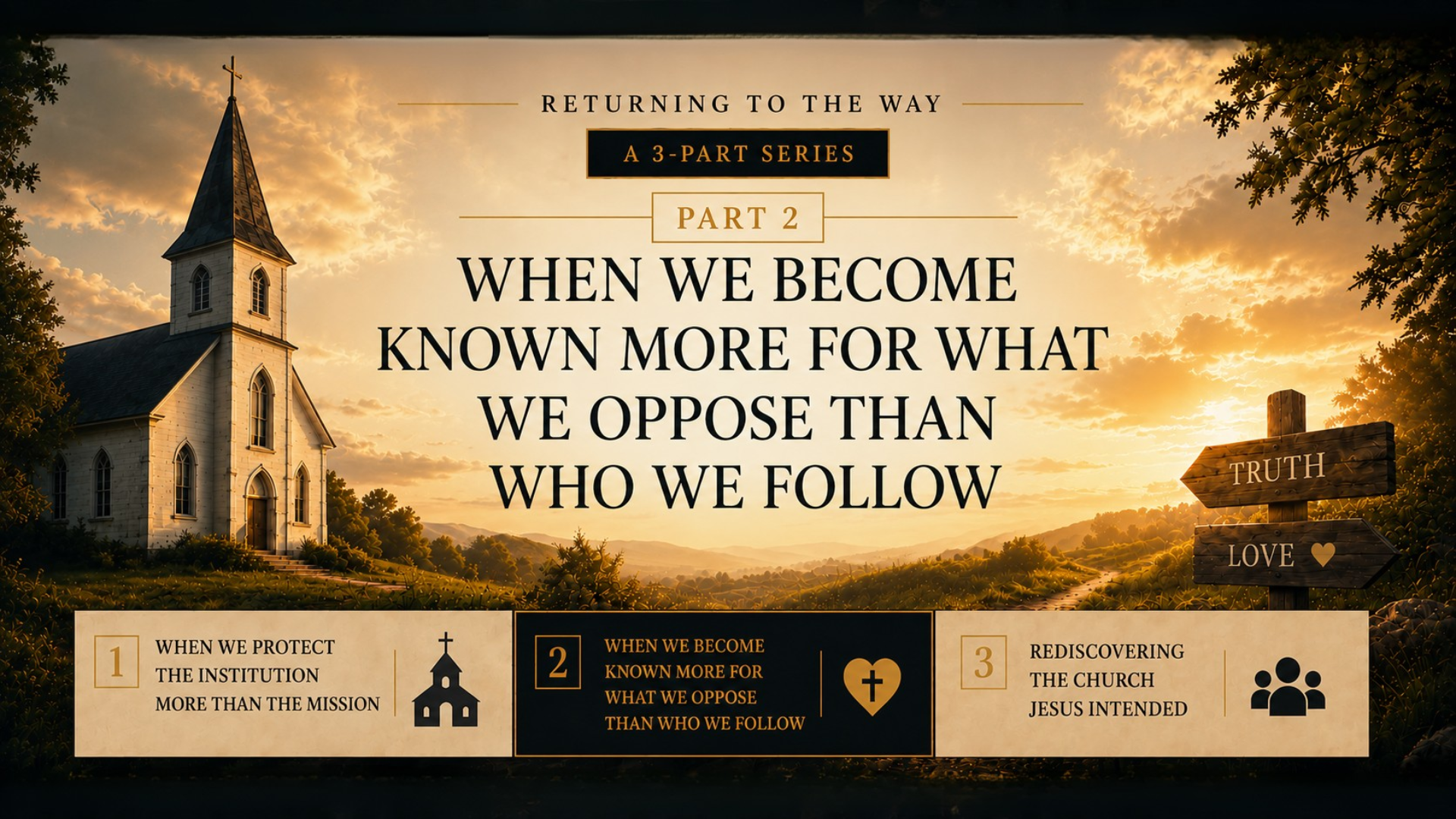
Returning to the Way (Part 2): When We Become Known More for What We Oppose Than Who We Follow
The Church is called to stand firmly on biblical truth, but are we equally known for the love of Christ? In Part 2 of Returning to the Way, we explore how truth and love were never meant to compete and why our witness should reflect both the convictions and compassion of Jesus.
Series: Returning to the Way
A three-part series exploring how the Church can rediscover biblical discipleship, servant leadership, and the mission Jesus entrusted to His people.
You are reading: Part 2 of 3
Next Article → Rediscovering the Church Jesus Intended
If there's one question that's really stuck with me over the years, it's this:
If someone completely unfamiliar with Christianity just watched our conversations, our social media posts, our public actions, and how we interact with our communities, would they think we’re mostly known for our love, or for what we oppose?
I must admit I am working on this one.
This question isn’t meant to downplay the significance of truth. In fact, it’s quite the opposite. The Bible consistently urges believers to stand firm in their faith, reject false teachings, and hold on to sound doctrine. The New Testament never suggests that Christians should water down their biblical beliefs just to fit in with the culture.
However, the New Testament also doesn’t separate truth from love.
Somehow, in various parts of today’s Christianity, we’ve acted like we have to pick one over the other. We’ve set up false dichotomies where love is seen as a weakness and truth is treated as a license for being harsh. But Jesus never exemplified either of those extremes.
He was overflowing with grace and truth.
Not just half grace and half truth.
Totally full of both.
Jesus never compromised on holiness, yet sinners were attracted to Him. He didn’t dilute God’s standards, but the broken found hope in His presence. He boldly confronted hypocrisy while showing incredible compassion to those who acknowledged their need for mercy.
That should make us think.
If Jesus perfectly represented truth and love, why do we often find it hard to keep them together?
Maybe part of the reason is that it’s easier to win arguments than to truly love people.
Arguments need information.
Love demands sacrifice.
You can win arguments from afar.
Love needs us to be close.
Arguments usually don’t cost us much. But love can cost us everything. The apostle Paul really got this struggle. When he wrote to the church in Corinth, a group dealing with division, pride, immaturity, and confusion about their beliefs, he didn’t just tell them to get smarter. He reminded them that knowledge without love is just hollow. He even claimed that someone could have amazing spiritual gifts, incredible faith, and deep understanding, but without love, it all means nothing.
That’s a pretty heavy thought.
Just think about it: standing in front of Christ one day and realizing that our focus on being doctrinally correct was never supposed to take the place of having a Christlike character.
Throughout the history of the church, every movement that has truly changed communities has been characterized by a mix of conviction and compassion. From believers saving abandoned babies in the early days, to Christians looking after plague victims while others ran away, to missionaries working hard to translate the Scriptures into languages that hadn’t been reached, and regular churches providing food for the hungry and support for widows, the Church shines brightest when it shows truth through acts of sacrificial love.
People didn’t just hear the gospel.
They witnessed it.
Yet, at some point, many of us have started to be more defined by our responses.
We respond to culture.
We respond to politics.
We respond to moral decay.
We respond to theological mistakes.
There's definitely a time and place to tackle these issues. Christians are meant to figure out what's true and what's not, and to speak up when it counts. But when our message turns mostly reactive, something sneaky starts to happen.
People begin to miss what we stand for because all they hear is what we're against.
It's ironic that Jesus spent way more time sharing the Kingdom of God than he did responding to the Roman authorities.
He dedicated much more time to healing the hurting than he did to criticizing society.
He focused way more on mentoring twelve disciples than on trying to get the thumbs up from the religious leaders.
His ministry was all about intention.
He didn’t overlook sin.
He just chose not to let sin take center stage in His mission.
His mission was all about redemption.
You can see the same theme in the book of Acts. The early Church didn’t gain recognition because they had the best political tactics or cultural sway. They became known because everyday people were so changed by the gospel that whole communities couldn’t help but notice what God was doing among them.
Their generosity was really noticeable.
Their unity was really noticeable.
Their courage was really noticeable.
Their compassion was really noticeable.
Their joy was really noticeable.
Even their opponents recognized that these believers had "turned the world upside down."
Sometimes I wonder if we've accidentally flipped our priorities.
Instead of asking, "How can we show Christ's love?" we often start with, "How can we defend Christianity?"
Defense has its role. The Scriptures tell believers to explain the hope they have inside them. But when apologetics is separated from love, it turns into just an intellectual fight.
The aim of defending the faith has never been about winning arguments.
The aim has always been about winning hearts.
This is where the Church needs to be cautious not to mix boldness with being abrasive.
Biblical boldness isn't just being loud for the sake of it.
It's about being faithful no matter the outcome.
Similarly, biblical love isn't just about being sentimentally tolerant.
It's about being honest because eternity is at stake, while also treating everyone as beings made in God's image.
When we share truth without love, it often drives people away before they can even hear the gospel.
On the flip side, love without truth doesn't change anyone through the gospel.
The Church needs a balance of both.
One of the clearest signs that something has gone off course is when non-believers are more aware of what Christians are against than who the Savior is that Christians share.
Just think if our communities recognized us mainly for how our ministries helped restore marriages.
For how lonely individuals found a family.
For how those struggling with addiction discovered hope.
For how single mothers received support.
For how foster kids found loving homes.
For how the needy were looked after.
For how prisoners were reached out to.
For how neighborhoods thrived simply because followers of Jesus were part of them.
Will people still have differing opinions about our beliefs?
Absolutely.
Even Jesus faced rejection.
The gospel has always challenged human pride.
However, there’s a significant distinction between people being upset by the message of the cross and being upset by the messenger.
One is sometimes unavoidable.
The other can often be avoided.
As followers of Jesus, we aren’t meant to create offense.
We’re meant to share Christ faithfully.
This calls for a humility that’s becoming increasingly rare in our society.
It means listening before we speak.
Serving before we demand.
Repenting before we criticize.
Loving before we label.
We need to remember that every individual we meet, no matter their beliefs, politics, lifestyle, or history, is someone for whom Christ sacrificed Himself.
That truth should influence every conversation we engage in.
Maybe this is one of the biggest challenges the Church faces today.
Not to lessen our commitment to truth.
But to be so filled with Christ’s love that every tough conversation, every biblical stance, every act of correction, and every public statement is clearly driven by the desire to see people reconciled to God.
When Jesus mentioned that the world would recognize His disciples by their love, He wasn’t outlining a marketing plan.
He was highlighting the proof of a changed heart.
So, the real question isn’t whether we’re standing for truth.
The real question is whether we’re standing for truth in a manner that reflects the heart of the One who is "full of grace and truth."
Because the world doesn’t just need Christians who are correct.
It needs Christians who embody Jesus.
In the next and final segment of this series, we’ll dive into what it looks like to return to biblical leadership and disciple-making, and why the future well-being of the Church relies not on creating better institutions but on developing individuals who genuinely follow Christ.
Rooted Reflection
One of the greatest temptations is to believe that standing for truth automatically means we are reflecting Christ. But Scripture calls us to something deeper. Jesus never asked His followers to choose between truth and love because He embodied both perfectly. As His disciples, our goal is not merely to be right, it is to become more like Him.
As you reflect on this article, resist the temptation to think only about the Church as a whole. Instead, ask the Holy Spirit to examine your own heart. How do you speak about people who disagree with you? Do your words point others toward Christ or simply reinforce your opinions? Every interaction is an opportunity to reflect the character of Jesus. May we become people who never compromise biblical truth, yet whose lives are so marked by humility, compassion, and love that even our hardest conversations reveal the heart of Christ.
Questions for Reflection
When people interact with me, are they more likely to remember my convictions or the love of Christ they experienced through me?
Have I ever allowed being "right" to become more important than representing Jesus well?
Are my conversations on social media, at work, and in my community marked by both truth and grace?
How can I intentionally demonstrate the love of Christ to someone with whom I strongly disagree this week?
Does my life reflect the balance of grace and truth that Jesus modeled, or do I naturally lean toward one at the expense of the other?
If someone only knew Jesus through my words and actions, what picture of Him would they see?
Continue Reading
➡️ Next in the Series
Returning to the Way (Part 3): Rediscovering the Church Jesus Intended
It's one thing to recognize where the Church has drifted, it's another to know how to move forward. In the final part of this series, we'll explore what it practically looks like to return to biblical leadership, disciple-making, and a Church marked by truth, love, repentance, and the mission of Christ.
Read Part 3 → Rediscovering the Church Jesus Intended

Returning to the Way (Part 1): When We Protect the Institution More Than the Mission
Has the Church become more committed to protecting institutions than pursuing the mission Jesus gave us? In Part 1 of this series, we explore the subtle shift from disciple-making to institution-building and why every church must continually measure itself by the authority of Scripture rather than tradition alone.
Series: Returning to the Way
A three-part series exploring how the Church can rediscover biblical discipleship, servant leadership, and the mission Jesus entrusted to His people.
You are reading: Part 1 of 3
Next Article → When We Become Known More for What We Oppose Than Who We Follow
I love the Church.
That statement really matters, because what comes next isn't coming from a place of cynicism or bitterness. It's coming from a place of genuine concern, strong belief, and hope. The Church is Christ's bride, His body, and the tool He chose to spread the gospel to everyone. Since I care about the Church, I think we need to be open to asking tough questions whenever we start to stray from the purpose for which Christ set her up.
One question has continued to press on my heart:
Are we now more focused on safeguarding Christian institutions rather than staying true to biblical faithfulness?
It's not about whether institutions are bad by nature. Over the years, God has worked through denominations, seminaries, mission groups, and local churches to achieve amazing things. Many lives have been changed because dedicated individuals poured their hearts into creating ministries that spread the gospel, developed leaders, and supported communities. Institutions can truly be wonderful blessings.
The real risk arises when the organization turns into the goal.
Every organization has this instinct to protect itself. Businesses do it, governments do it, schools do it, and churches are no exception. Over time, there can be a subtle shift where safeguarding reputation takes precedence over seeking repentance, keeping attendance becomes more crucial than making disciples, and upholding tradition overshadows the need for biblical correction.
The Bible shows us time and again that God’s main concern isn’t about keeping religious systems intact. His focus has always been on the hearts of His people.
In the Old Testament, Israel went through periods of incredible blessings followed by painful rebellion. When the nation strayed, God didn’t send prophets to safeguard its image. Instead, He sent prophets to urge His people back to their covenant with Him. Their message was consistently clear: repent, return, and remember the God who saved you.
Jesus continued that same pattern.
When Christ was around the religious leaders of His time, He didn't reserve His harshest words for tax collectors, prostitutes, or Roman officials. Instead, He aimed them at those who had mastered religion but overlooked the essence of God. They were well-versed in Scripture, followed traditions closely, and defended their beliefs with great fervor. However, Jesus revealed a deeper issue. In their quest to uphold their traditions, they started to ignore justice, mercy, faithfulness, and true love for both God and their neighbors.
One of the most striking realities in the Gospels is that individuals can be intensely devoted to religious practices while drifting away from the heart of God.
That possibility should humble every one of us.
We should also remember that the solution isn't to walk away from the Church. Instead, it's about letting the Church be constantly renewed by the Word of God.
When Jesus shared what we often refer to as the Great Commission, His guidance was quite straightforward. He didn't instruct His followers to create grand organizations, set up complex ministry frameworks, or gain cultural power. He simply told them to make disciples, baptize them, and teach them to follow all that He had commanded.
The mission was always pretty straightforward.
Follow Jesus.
Assist others in following Jesus.
Do it again.
Everything the Church creates, be it buildings, budgets, programs, denominations, or leadership structures, is meant to support that mission, not to take its place.
Sadly, many churches have gotten really good at bringing people together without truly making disciples. We’ve nailed marketing. We’ve polished our production skills. We’ve crafted strategic plans and organizational charts. None of this is bad in itself. Actually, these can be great tools. But they become risky when they begin to replace the work only the Holy Spirit can do.
The New Testament doesn't just look at attendance to gauge success.
It focuses on faithfulness.
Are disciples being made?
Is the gospel moving forward?
Are believers becoming more holy?
Are leaders training the saints?
Are the needy being looked after?
Is Christ being honored?
These questions are quite different from what we usually consider today.
This tension really stands out when moral failures or abuse happen in Christian organizations. Too often, our instinct is to shield the ministry, defend the leader, protect the reputation, or downplay the damage. We tell ourselves that revealing sin could harm the Church's witness.
But Scripture clearly teaches the opposite.
Concealed sin never bolsters the witness of God's people.
Repentance does.
Confession does.
Humility does.
Truth does.
The Church's credibility has never depended on looking flawless. It has always been about directing people to the only One who truly is.
That’s why I think the Church's biggest need today isn’t another strategic plan.
It’s repentance.
Not just personal repentance, though that’s crucial. We also need corporate repentance. We need churches ready to acknowledge where they’ve strayed, leaders willing to admit their failures, and congregations open to questioning whether long-standing traditions still support the mission Christ gave to His followers.
This isn’t a call to tear down every institution.
It’s a call to assess every institution against the Word of God.
Every ministry should regularly confront tough questions.
Are we making disciples or just drawing in attendees?
Are we equipping believers or just entertaining consumers?
Are we holding onto traditions that help people follow Jesus, or just those that make us feel comfortable?
Would our ministry still achieve its purpose if our building vanished tomorrow?
Most importantly, are we helping people know Christ more deeply, obey Him more faithfully, and love Him more completely?
These questions aren’t threats to the Church.
They’re acts of love.
Healthy things are open to examination.
Healthy churches are open to correction.
Healthy leaders are open to repentance.
Maybe the first step toward renewal isn’t asking God to change the culture around us.
Maybe it’s asking Him to start with us.
Every significant movement of God throughout history has started in a similar fashion, not with individuals clinging to their creations, but with people humbly turning back to the One who established His Church.
Before we dive into how to transform the Church, we need to first reflect on a much more personal question:
Am I more focused on safeguarding what I know than on following Christ wherever He guides?
That's the starting point for every revival.
Rooted Reflection
It is easy to critique the Church from a distance. It is much harder, and much more biblical, to allow God to examine our own hearts first. Institutional drift doesn't begin with organizations; it begins with individuals. Every church is made up of people like you and me. If we long to see renewal in the Church, we must first invite Christ to renew us.
Perhaps the question isn't simply whether the Church has drifted. Perhaps the better question is, Have I drifted? Am I more concerned with preserving what is familiar than faithfully following wherever Jesus leads? Revival has always begun with people who were willing to let God change them before asking Him to change everyone else.
Questions for Reflection
Where have I confused tradition with biblical conviction?
Am I contributing to disciple-making or simply attending church?
What would need to change in my own life if I took the Great Commission more seriously?
Continue Reading
➡️ Next in the Series
Returning to the Way (Part 2): When We Become Known More for What We Oppose Than Who We Follow
How can the Church faithfully hold to biblical truth while ensuring love, not outrage, remains the defining mark of our witness?
Read Part 2 → When We Become Known More for What We Oppose Than Who We Follow