BEYOND THE HEADLINES
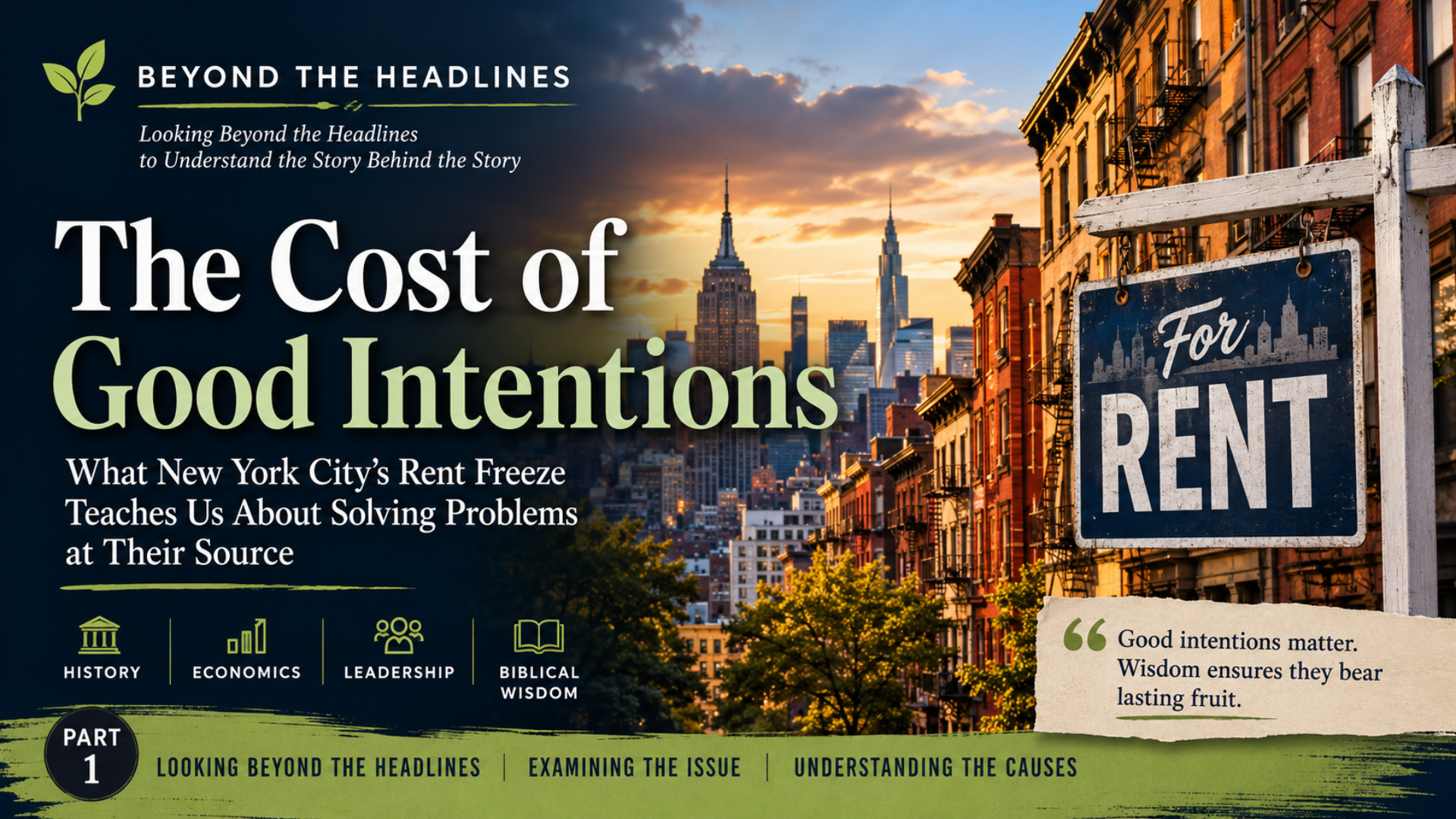
New York City's rent freeze has sparked passionate debate across the political spectrum. While many view it as an important step toward protecting struggling families, others question whether it addresses the deeper issues driving housing affordability. In this first installment of Beyond the Headlines, we explore the history, economics, and leadership principles behind the policy and ask a simple but important question: Are we treating the symptom, or solving the problem?
A series from The Rooted Life exploring today's biggest issues through history, research, economics, leadership, and biblical wisdom.
The Cost of Good Intentions
What New York City's Rent Freeze Teaches Us About Solving Problems at Their Source
Author's Note
Housing affordability is one of the most pressing challenges facing millions of Americans today. Families across the country are struggling with rising rents, increasing home prices, and the growing cost of simply putting a roof over their heads. Those challenges deserve serious attention, thoughtful discussion, and genuine compassion.
The purpose of this article is not to criticize the desire to help struggling families. In fact, I believe caring for those facing financial hardship is both a moral responsibility and a biblical value. Instead, my goal is to ask a different question: Do the policies we choose actually solve the problems they are intended to address, or do they provide temporary relief while allowing the underlying issues to remain?
Reasonable people can disagree on public policy. My hope is not to convince you to adopt my opinion simply because it is mine, but to invite you to look beyond the headlines, consider the historical evidence, examine the incentives these policies create, and think carefully about what leads to lasting human flourishing.
Introduction
Imagine a family whose home has developed a serious crack in its foundation.
At first, the damage appears minor. A few doors no longer close properly. Small cracks begin appearing in the drywall. Windows become increasingly difficult to open. Rather than repairing the foundation, however, the family decides to repaint the walls, replace the trim, and patch the visible cracks every few months.
For a while, the house looks better.
Visitors don't notice anything wrong.
The symptoms have been covered.
But beneath the surface, the foundation continues shifting. Eventually, the cracks return, the walls begin separating, and the repairs become more expensive than they would have been had the underlying problem been addressed from the beginning.
Life often works this way.
So does leadership.
And, quite often, public policy.
One of the greatest temptations facing leaders is to solve the problem everyone can see while overlooking the conditions that created it. The visible symptom receives immediate attention because it demands an immediate response. The deeper issue, however, is usually slower, more complicated, and far less politically rewarding to address.
That brings us to one of the most talked-about housing policies in America today.
In June 2026, New York City approved a rent freeze affecting approximately one million rent-stabilized apartments. For many residents, the decision was welcome news. At a time when housing costs continue climbing and many families struggle to keep pace with inflation, preventing another rent increase offered immediate financial relief.
Supporters viewed the decision as an act of compassion. They argued that many working families simply cannot absorb another increase in housing costs and that government has a responsibility to protect vulnerable renters from being priced out of their homes.
That concern is understandable.
Stable housing matters.
Communities matter.
Keeping families in their homes matters.
No thoughtful person should dismiss those concerns lightly.
Yet good public policy requires us to ask another question as well.
Will this policy merely relieve today's pressure, or will it help solve the conditions that caused housing to become unaffordable in the first place?
That question forms the heart of this article.
Looking Beyond the Headlines
Public debate often encourages us to think in simple categories.
Either you're for renters.
Or you're for landlords.
Either you support affordable housing.
Or you support developers.
Either you care about struggling families.
Or you care about free markets.
Reality is rarely that simple.
Most people, including those on opposite sides of this debate, want many of the same things. They want affordable housing. They want safe neighborhoods. They want thriving communities. They want families to remain in their homes. They want opportunities for future generations to build stable lives.
The disagreement is usually not over the desired outcome.
The disagreement is over the best path to achieving it.
Supporters of New York City's rent freeze argue that the policy provides immediate protection for families already struggling with rising housing costs. Many believe that without intervention, long-time residents could be displaced from neighborhoods they have called home for decades. From this perspective, a rent freeze offers stability while broader housing initiatives are pursued.
Critics, however, raise a different concern.
They argue that while freezing rent may provide short-term relief for current tenants, it does little to address the underlying housing shortage that has driven prices upward over many years. Some economists warn that if such policies reduce investment in housing or discourage future construction, the long-term result could be an even tighter housing market and fewer affordable options for future renters.
These are two fundamentally different ways of thinking about the same problem.
One asks,
"How do we reduce the financial burden people face today?"
The other asks,
"Why has housing become so expensive in the first place?"
Both questions matter.
But only one seeks to identify the source of the problem.
Treating the Symptom Instead of the Disease
One of the oldest principles in medicine is remarkably simple.
Treating symptoms can bring temporary relief.
Treating the disease brings lasting healing.
Imagine visiting your physician because you have developed a serious bacterial infection. After examining you, the doctor notices that you have a high fever. Instead of prescribing antibiotics to eliminate the infection, the doctor gives you medication that lowers your temperature.
Within a few hours, you begin feeling much better.
The fever is gone.
Your symptoms have improved.
But the infection itself remains.
Days later, the fever returns because the underlying illness was never addressed.
Housing affordability can be viewed through a similar lens.
High rent is the symptom.
Housing scarcity is the disease.
Freezing rent may reduce immediate financial pressure for many current tenants, but it does not create additional housing, lower construction costs, simplify permitting, or remove barriers that have made it increasingly difficult to build enough homes to meet demand.
That does not mean a rent freeze has no value.
Temporary relief can be important during periods of genuine hardship.
The larger question, however, is whether temporary relief is being accompanied by reforms capable of addressing the deeper structural causes of the crisis.
If not, today's relief may postpone tomorrow's problem.
That distinction is worth exploring because history has repeatedly demonstrated that solving symptoms without addressing root causes often produces unintended consequences.
Before evaluating those consequences, however, we must first understand how New York, and many other American cities, arrived at this point.
Understanding What Created the Housing Crisis
Housing shortages rarely develop overnight.
They are usually the product of many decisions made over decades.
Population growth increases demand.
Construction struggles to keep pace.
Land becomes more expensive.
Labor costs rise.
Building materials become more costly.
Environmental reviews become lengthier.
Permitting processes become more complex.
Neighborhood opposition delays or prevents new development.
Property taxes increase.
Financing becomes more expensive.
None of these factors alone created New York City's housing challenges.
Together, however, they have contributed to a market where demand has consistently outpaced supply.
Like any marketplace, housing is influenced by the relationship between supply and demand.
When demand grows faster than the available supply of homes, prices generally rise. That principle applies whether we are discussing apartments in Manhattan, homes in rural communities, or nearly any other market where more people want a product than currently exists.
Understanding this point is essential because it changes the conversation.
If high rent is primarily the result of an insufficient housing supply, then policies designed only to limit prices may relieve immediate pressure without significantly increasing the number of homes available.
That doesn't necessarily make such policies wrong.
It simply means they may be addressing the symptom while leaving the underlying shortage largely unchanged.
And that raises the next question.
What happens when the price of housing is frozen, but the costs of providing that housing continue to rise?
That is where the conversation becomes even more interesting.
Beyond the Headlines
Looking Beyond the Headlines to Understand the Story Behind the Story
About This Series
In a world filled with headlines, hot takes, and political talking points, Beyond the Headlines exists to encourage thoughtful conversations about today's biggest issues. Each article explores history, research, economics, leadership, and biblical wisdom to help readers look beyond the surface and think more deeply about the world around them.
📬 Don't miss the next post.
Join the List: to receive New Blog Post Updates at therootedlife.online delivered straight to your inbox.