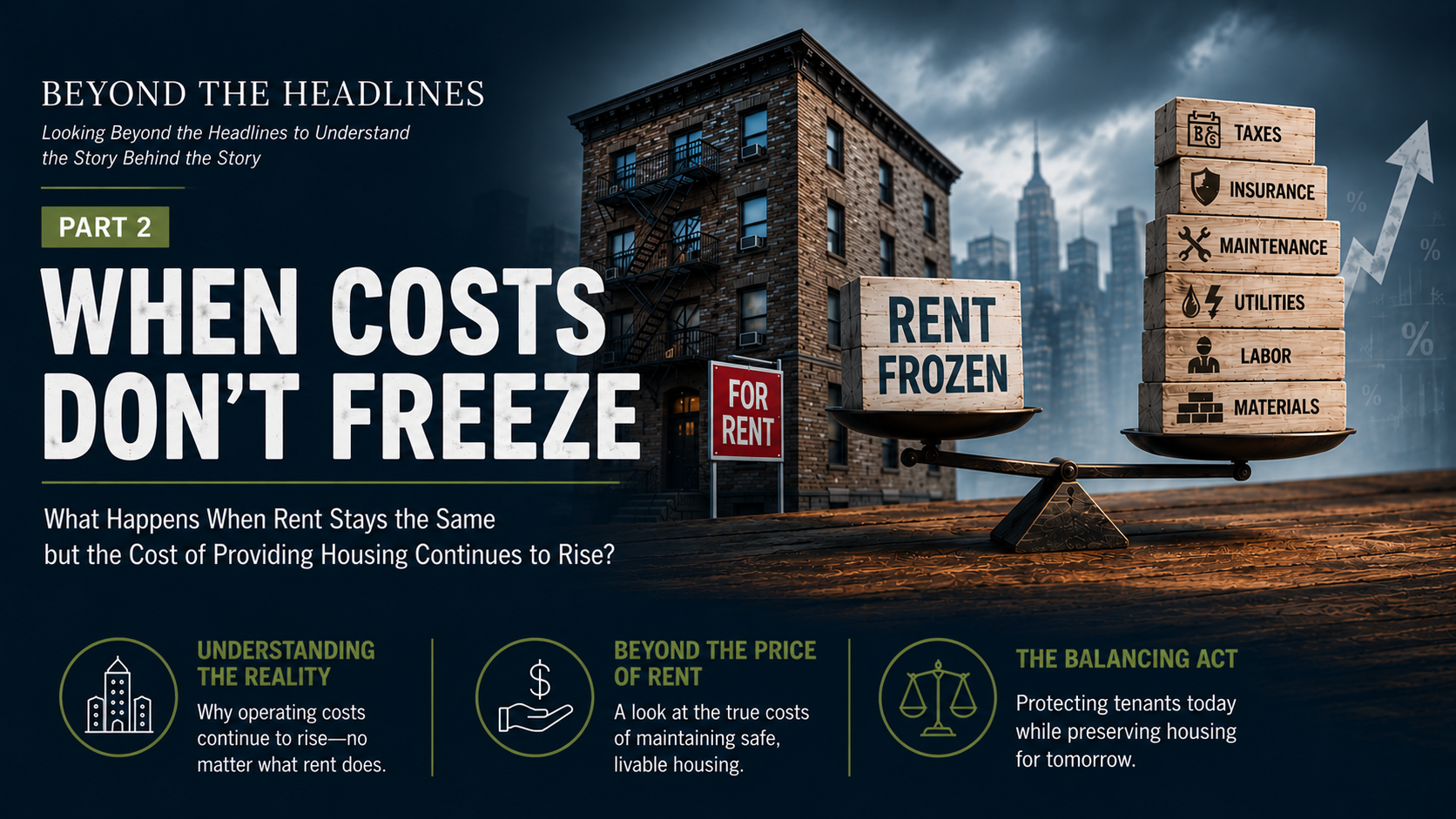
WHEN COSTS DON’T FREEZE
At the end of the first article, we asked a simple but important question: What happens when rent is frozen, but the cost of providing housing continues to rise? In this second installment of Beyond the Headlines, we examine the financial realities of operating rental housing, explore historical examples from New York, San Francisco, and Stockholm, and consider how good intentions can create unintended consequences when long-term incentives are overlooked.
What Happens When Rent Stays the Same but the Cost of Providing Housing Continues to Rise?
Beyond The Headlines
Looking Beyond the Headlines to Understand the Story Behind the Story
An Editorial Feature from The Rooted Life
Author's Note
At the end of my previous article, The Cost of Good Intentions, I left readers with a question:
What happens when the price of housing is frozen, but the cost of providing that housing continues to rise?
That question lies at the heart of nearly every debate surrounding rent regulation.
Before continuing, it's important to acknowledge something often missing from these conversations. Housing is deeply personal. Behind every statistic is a family trying to remain in the neighborhood they love, a retiree living on a fixed income, a young couple saving for their first home, or a property owner trying to maintain a building that may have been in their family for generations.
These discussions deserve more than political slogans.
They deserve thoughtful analysis.
The goal of this article is not to defend landlords or criticize tenants. Nor is it to suggest that every landlord behaves responsibly or that every housing policy fails. Rather, my goal is to examine an often-overlooked reality: while governments can temporarily freeze the price tenants pay, they cannot freeze the costs required to operate and maintain housing.
Understanding that distinction helps explain why economists, housing experts, tenant advocates, and policymakers continue to debate rent regulation decades after it first appeared.
Introduction
Imagine owning a small apartment building that has been in your family for thirty years.
The roof eventually needs replacing.
The boiler reaches the end of its life.
Insurance premiums increase.
Property taxes rise.
Water and sewer rates climb.
Landscapers charge more.
Electricians charge more.
Plumbers charge more.
Construction materials become more expensive.
Even routine maintenance, painting hallways, repairing sidewalks, servicing elevators, replacing appliances, costs more than it did just a few years earlier.
Now imagine that while every one of those expenses continues increasing, the primary source of revenue supporting the building remains unchanged.
For many people outside the housing industry, this is the part of the conversation that often receives little attention.
Housing isn't simply a product.
It is an asset that requires continuous investment to remain safe, functional, and livable.
Unlike a completed project that never changes, apartment buildings are constantly aging. Roofs wear out. Pipes corrode. Heating systems fail. Parking lots deteriorate. Fire safety systems require inspections. Local governments update building codes. Insurance companies adjust premiums to reflect changing risks.
Whether a building contains ten apartments or two hundred, the physical realities of ownership never stop.
That reality exists regardless of politics.
What History Teaches
Public policy is often driven by good intentions, but history reminds us that good intentions do not always produce the outcomes policymakers hope for. One of the greatest advantages we have when evaluating modern policies is that we don't have to rely solely on theory. Rent regulation has existed in various forms around the world for decades, giving researchers an opportunity to study what has happened in real communities over time.
The results are not always simple. In many cases, rent regulation has provided meaningful short-term stability for existing tenants. At the same time, many researchers have concluded that prolonged rent regulation can also create challenges for future renters by reducing housing supply, discouraging investment, or changing the incentives surrounding rental housing. Understanding both sides of that equation is essential if we want to learn from history rather than simply repeat it.
When Costs Keep Rising
One of the most common misunderstandings surrounding rent regulation is the assumption that if rent remains unchanged, the financial picture of owning rental housing also remains relatively stable.
History suggests otherwise.
Operating costs rarely remain flat for long.
Inflation alone affects nearly every expense associated with housing. Labor becomes more expensive. Building materials increase in price. Utility costs fluctuate. Insurance markets respond to weather events and claims history. Interest rates influence borrowing costs. Local governments periodically reassess property values, affecting tax obligations.
The building itself doesn't know whether rent has increased.
It simply continues aging.
This is one reason organizations representing both landlords and tenants frequently present very different pictures of the same housing market.
Tenant advocates often focus on affordability, displacement, and housing stability.
Property owners frequently point to operating costs, maintenance obligations, financing, and regulatory requirements.
Both perspectives describe real challenges.
The question is how those realities interact over time.
The Financial Reality of Housing
One of the reasons this debate has persisted for decades is because rental housing operates within a delicate financial balance.
Rental income typically pays for more than a mortgage.
It also funds insurance premiums, property taxes, maintenance staff, repairs, utilities for common areas, security systems, landscaping, snow removal where applicable, legal compliance, capital improvements, emergency repairs, and reserves for future maintenance.
When major components fail, the costs can be staggering.
Replacing a roof on a multi-family building may cost hundreds of thousands of dollars.
Installing a new boiler or HVAC system can represent another significant capital expense.
Elevator modernization often reaches well into six figures.
Water intrusion, structural repairs, or electrical upgrades may require substantial additional investment.
These expenses don't occur because owners are expanding their profits.
Many occur simply because buildings deteriorate over time.
Responsible ownership requires continual reinvestment.
Without that investment, housing quality inevitably declines.
San Francisco: Protection for Some, Fewer Homes for Others
One of the most influential studies on modern rent control was published in 2019 by economists Rebecca Diamond, Tim McQuade, and Franklin Qian at Stanford University. Their research examined the expansion of rent control in San Francisco during the 1990s and followed its long-term effects.
The study found that rent control provided significant benefits for many existing tenants. Individuals covered by the policy were less likely to move and were better able to remain in neighborhoods experiencing rapid increases in housing costs. For families worried about displacement, those findings are important and should not be dismissed.
However, the researchers also identified unintended consequences.
Over time, many property owners responded by converting rent-controlled apartments into condominiums, owner-occupied housing, or other forms of residential property that were no longer subject to rent regulations. Some redeveloped existing buildings entirely.
According to the study, these responses contributed to a reduction in the supply of rental housing while increasing the value of owner-occupied homes. The researchers estimated that the expansion of rent control ultimately reduced the city's supply of rental housing by approximately 15 percent within the affected group of properties.
That conclusion doesn't mean rent control failed completely.
It means the policy accomplished one objective, protecting many current tenants, while simultaneously creating new challenges for future renters searching for available housing.
That distinction matters because public policy often involves trade-offs rather than perfect solutions.
Stockholm: When Affordable Housing Becomes Difficult to Access
Stockholm offers another instructive example.
Sweden's capital has long maintained a system in which rents are negotiated rather than determined entirely by market forces. The goal has been to provide affordable housing while protecting tenants from sudden rent increases.
The policy has succeeded in one important respect.
Many tenants fortunate enough to obtain regulated apartments pay rents below what comparable market-rate housing might otherwise cost.
The challenge, however, has been access.
Because regulated apartments are highly desirable and turnover remains low, waiting lists have grown extraordinarily long. In some areas, prospective tenants have waited many years, and in certain neighborhoods, more than a decade, for the opportunity to secure a regulated apartment.
As a result, informal subletting arrangements and secondary housing markets have developed. Some individuals pay significantly higher prices for short-term rentals simply because they cannot obtain regulated housing through official channels.
The lesson from Stockholm is not that affordable housing is undesirable.
Rather, it demonstrates that affordability means little if families cannot actually obtain housing in a reasonable amount of time.
Affordable housing must also be available housing.
New York: A Continuing Balancing Act
New York City has wrestled with these questions longer than almost any other city in America.
Supporters of rent stabilization argue that the system has allowed millions of residents to remain in neighborhoods that would otherwise have become financially inaccessible. Many credit rent regulation with preserving community stability and protecting long-term tenants from dramatic rent increases during periods of rapid economic change.
Critics, however, point to another reality.
Operating costs continue rising regardless of rent policies.
The New York City Rent Guidelines Board annually reviews changes in expenses such as insurance, labor, fuel, taxes, maintenance, utilities, and administrative costs before determining allowable rent adjustments. Those reports consistently demonstrate that the costs of operating apartment buildings fluctuate with inflation and changing economic conditions.
When revenues remain relatively flat while expenses continue increasing, some owners argue they are forced to delay capital improvements, postpone maintenance, or reconsider future investments. Tenant advocates correctly respond that landlords also have legal obligations to maintain safe housing regardless of financial pressures and that poor maintenance cannot simply be excused by rising costs.
Both concerns are legitimate.
The challenge for policymakers is designing a system that protects tenants without unintentionally discouraging the long-term investment required to preserve and expand the housing supply.
Incentives Shape Future Decisions
These examples reveal a broader principle that extends far beyond housing.
People respond to incentives.
When financial conditions make it increasingly difficult to earn a reasonable return on investment, future investment often slows.
Developers become more cautious.
Lenders become more selective.
Property owners postpone major projects.
Investors direct capital toward communities that appear more financially predictable.
This doesn't happen because people suddenly become less compassionate.
It happens because financial decisions are influenced by expectations about future risk and future returns.
The important question, then, is not simply whether a rent freeze helps today's tenants.
The question is whether the policy creates incentives that encourage enough housing to be built, maintained, and preserved for tomorrow's tenants as well.
History suggests that this balance is one of the most difficult challenges facing housing policy.
Looking Ahead
History teaches us that protecting existing tenants and creating abundant future housing are both worthy goals.
The difficulty lies in designing policies that accomplish both at the same time.
If freezing prices alone cannot fully solve the housing crisis, and if allowing prices to rise without restraint creates genuine hardship for many families, then a larger question remains.
➡️ What Makes Housing Affordable?
Looking Beyond Political Talking Points to Understand Why Some Communities Thrive While Others Struggle
Continue the Conversation
If you enjoyed this post:
📬 JOIN THE LIST: Receive New Blog Posts and Updates from therootedlife.online, delivered directly to your inbox.
✓ No spam.
✓ Just thoughtful, content designed to help you grow in faith and engage the world with wisdom.
Resources
New York City Rent Guidelines Board, annual Price Index of Operating Costs reports.
Joint Center for Housing Studies of Harvard University, The State of the Nation's Housing.
Urban Institute, research on housing affordability and supply.
Brookings Institution, housing and land-use policy research.
Organisation for Economic Co-operation and Development (OECD), housing market analysis.